


Don’t Build a Shopify App Until You Read This.
Building a successful Shopify app is often described as a matter of execution: solid engineering, clear UX, and enough persistence. In reality, even products that meet all of these criteria can fail.
This article examines the lifecycle of Grammar Content Assistant — a Shopify app developed by DevIT Software — from its initial idea to its eventual shutdown in early 2026. It is a practical case study on how a product can solve a real problem, be technically sound, and still struggle to achieve sustainable traction in the world of Shopify app development.
The Idea That Felt Obvious
Every Shopify store is built on content: product descriptions, collections, blogs, pages, email templates, and localizations. That content directly affects SEO performance, customer trust, and brand perception.
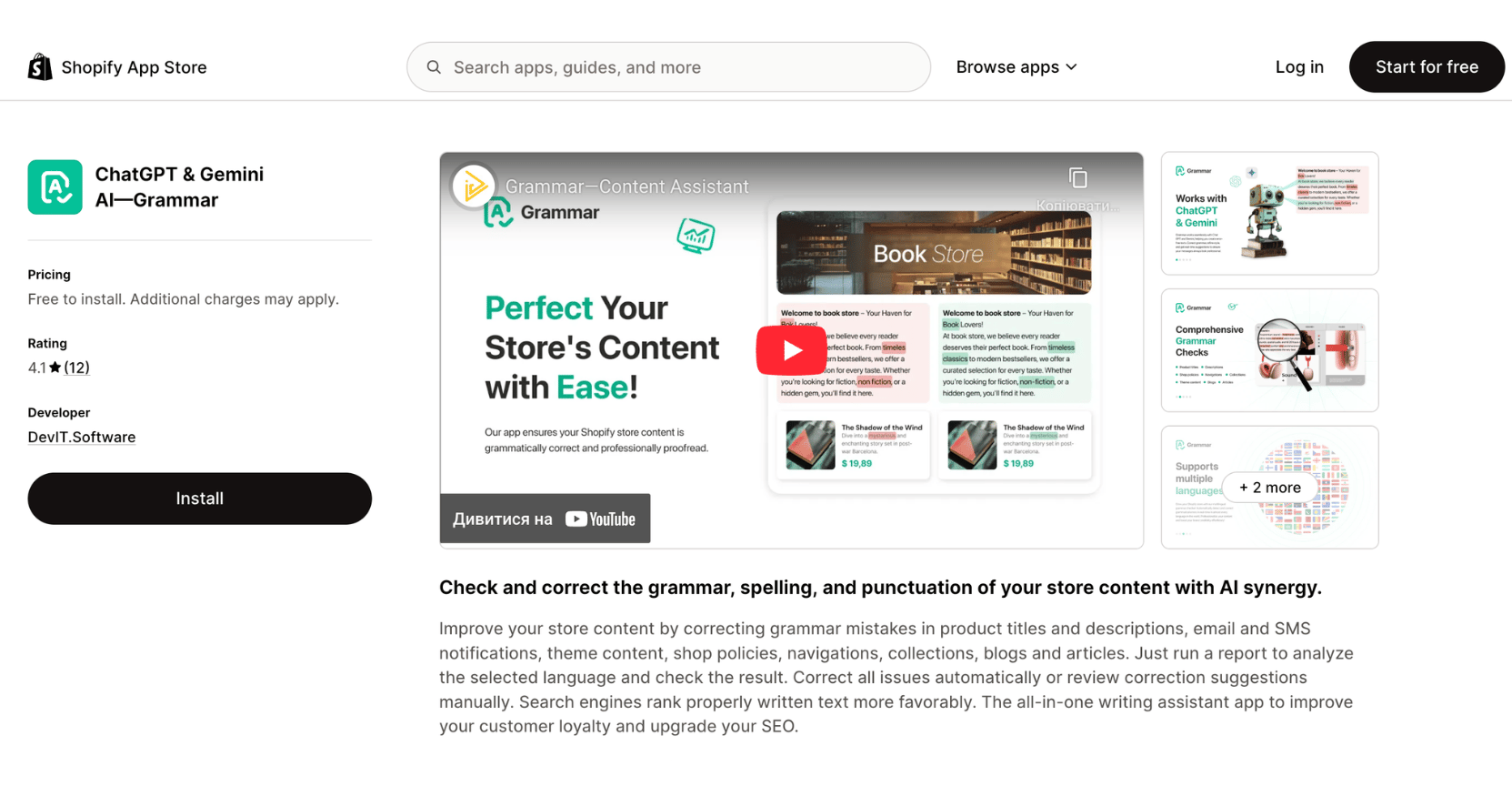
We believed grammatical mistakes were an underestimated but meaningful problem. Not dramatic enough to trigger alarms, but serious enough to quietly hurt conversions and credibility at scale. That belief led us to build Grammar Content Assistant — an app designed to analyze and improve grammar across an entire Shopify store at once. Not page by page. Not manually. Systematically.
What Made Grammar Content Assistant Different
The product was not about fixing a sentence here and there. Its core value proposition was mass analysis:
- Scanning the entire store in one run
- Selecting specific content types (products, collections, blogs, emails, localizations)
- Supporting multiple languages
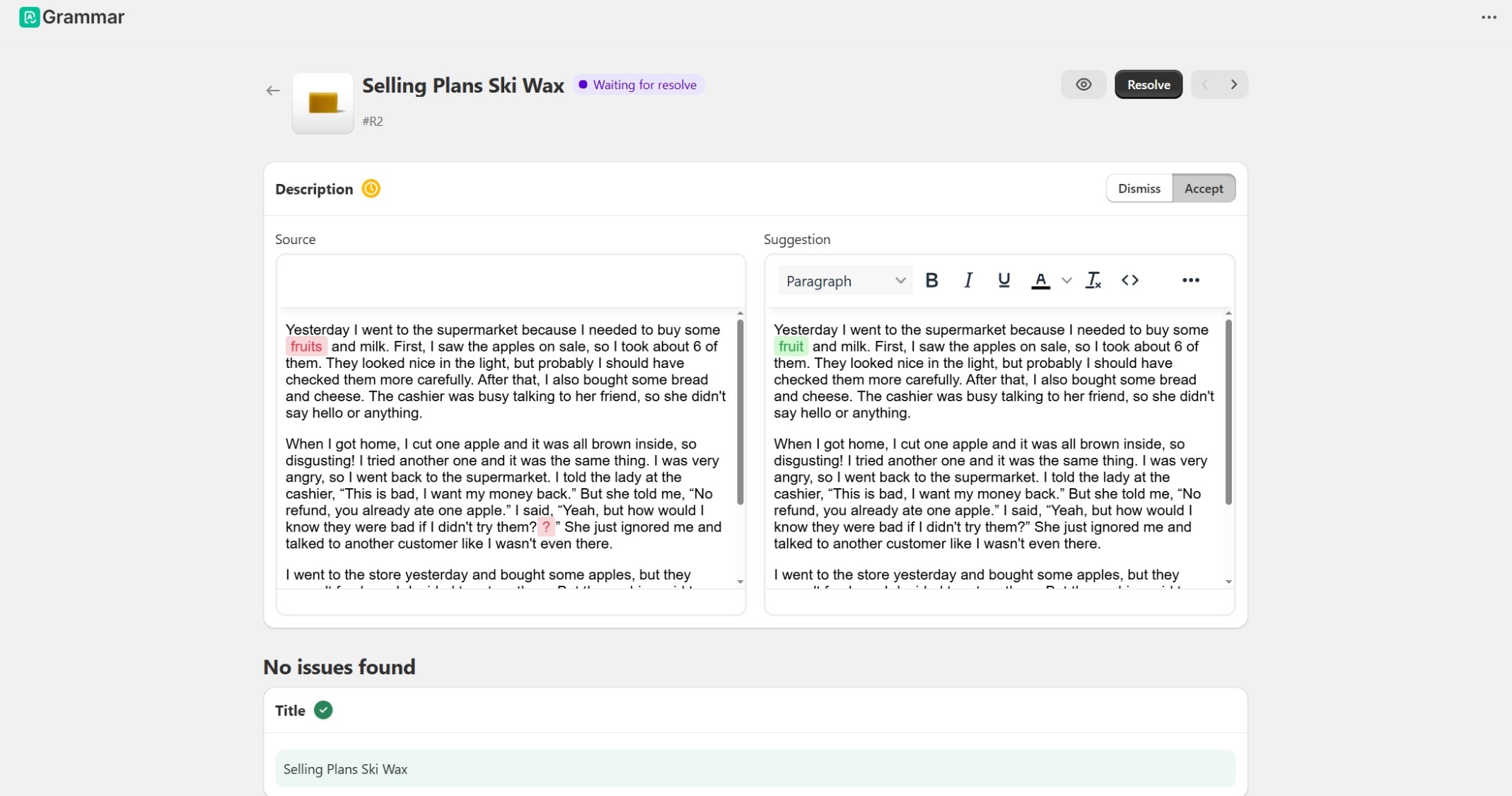
- Generating structured reports with issues and recommendations
- Allowing merchants to apply fixes automatically or review them manually
Unlike browser-based tools like Grammarly, which operated locally, our app ran in the background and integrated directly with Shopify.dev API to target the full scope of a store. To make the app feel native in the Shopify admin, we built the interface using Shopify Polaris, Shopify’s official UI component library for app developers. This helped us to align with the platform’s UX patterns and reduce friction for merchants.
First Release and Technical Reality (2023)
The first version of the app launched on August 18, 2023. At that stage, it did not rely on AI. We used public grammar solutions such as LanguageTool to power the analysis. Very quickly, we ran into a hard reality: real Shopify content is not “just text.” HTML markup, Liquid templates, email layouts, and dynamic variables fundamentally complicate grammar analysis.
To make the checks work, we had to strip HTML before analysis and then attempt to reconstruct it afterward. Context was lost. Structures broke. Results became inconsistent. The MVP was unstable, difficult to maintain, and prone to edge‑case failures. We rotated developers, rewrote background processes, and patched critical issues — yet the product remained technically fragile for a long time.
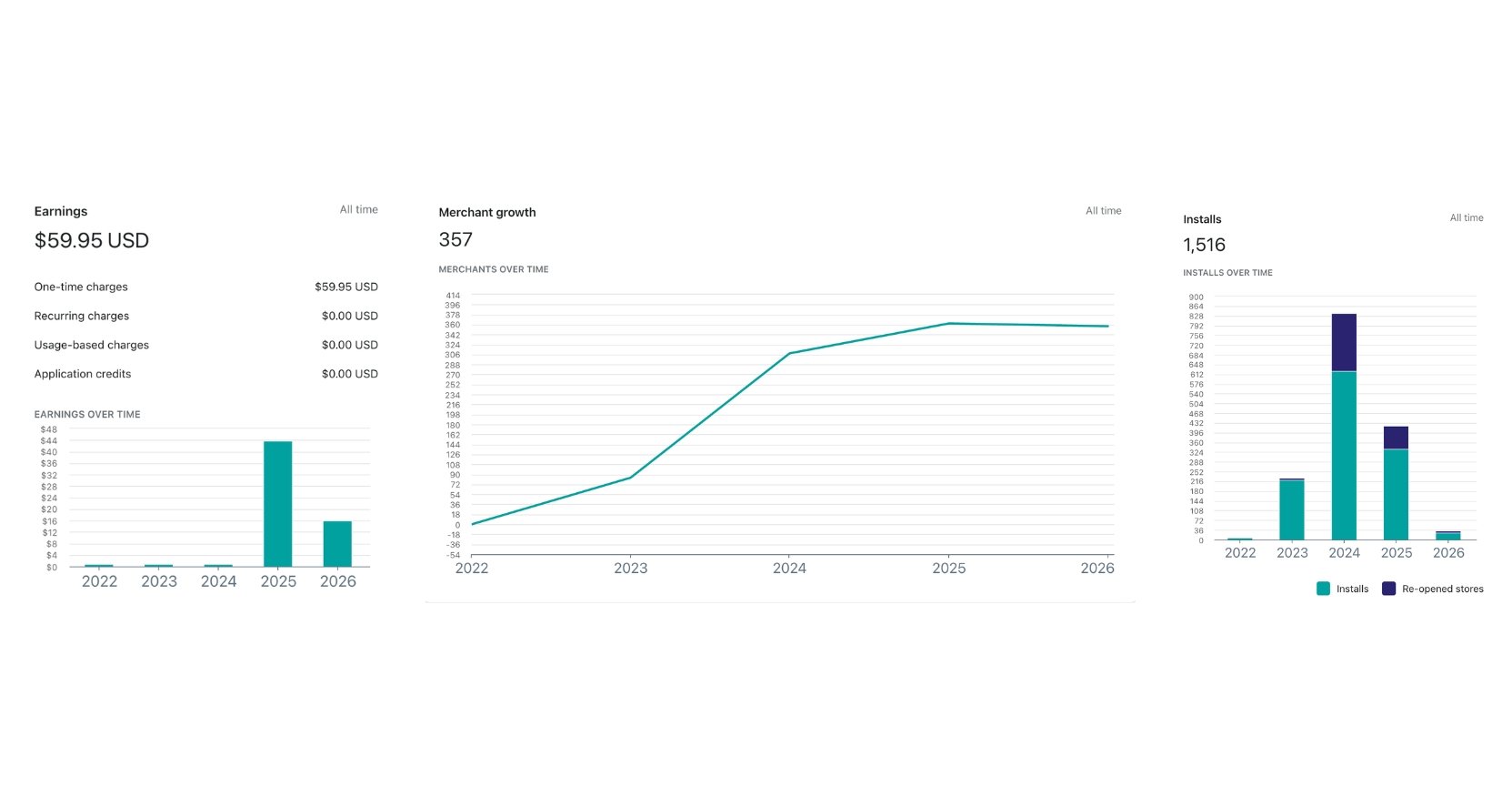
Despite this, the novelty of a free tool led to 335 installs in the remaining months of 2023.
Switching to AI — and Rising Expectations (2024-2025)
In mid-2025, we fully rebuilt the application and integrated AI. From a quality standpoint, this was a breakthrough. We integrated advanced AI via Google AI Studio and OpenAI Platform. AI could process content holistically without breaking on HTML or Liquid structures.
To support this, we deployed a professional-grade infrastructure:
- Hetzner: A dedicated virtual machine for app logic and a dedicated server for the database.
- Cloudflare: Utilizing R2 for storage, plus CDN and DNS for global performance and security.
Our Partners Dashboard showed a peak of 839 installs in 2024 as we iterated. We also maintained 24/7 customer support. While we don't include a specific cost for this team (as they support our entire portfolio), 24/7 availability is an essential standard for any reputable Shopify app.
Monetization Changed the Dynamic: $100,000 vs. $59.95
AI, however, comes with real costs. We chose a transparent pricing model: merchants paid per report based on the number of AI tokens used. To reduce friction, we introduced:
- A free trial with 10,000 tokens
- A demo report using sample products
- Minimal markup over the actual AI cost
Despite this, prices starting at $5–15 became a psychological barrier.
When the app was free, nearly every installed store ran an analysis. Once monetization was introduced, the conversion from installation to first report dropped sharply. The gap was massive. Over the app's lifetime, we saw 1,616 total installs and 1,159 uninstalls, reaching a current merchant base of 357. We invested roughly $100,000 in development, MVP iterations, and support, only to generate a total lifetime revenue of $59.95 USD.
Market Feedback
User feedback reflected this shift:
- “The app was great when it was free.”
- “Why pay for this if ChatGPT is free?”
- “Don’t install — it broke my store.” (despite rollback mechanisms being in place)
With a relatively small user base, even a handful of negative reviews had a disproportionate impact on ratings and discoverability.
Why the App Didn’t Scale
In retrospect, the issue went beyond execution:
- The niche was narrower than expected
- Grammar is useful, but rarely revenue‑driving
- Merchants prioritized translations and sales features over content quality
- The absence of a sustainable free tier increased friction
The central lesson became clear: usefulness does not automatically translate into perceived value.
In the Shopify ecosystem, selling an app that doesn't directly help merchants generate revenue is nearly impossible. Even if the product is high-quality, if it doesn't bring revenue, merchants view it as an optional luxury rather than a necessity.
Furthermore, an app that doesn't generate significant revenue is effectively impossible to sell or exit. The costs of legal migration, contract negotiations, and the time spent on a "handover" would far exceed the actual market value of the app.
The Decision to Shut Down
After the AI relaunch, we monitored performance closely. Six months later, the growth trajectory had not changed. For another two months, the app continued running without active development.
The decision to shut it down was made by the CEO and COO.
We followed the official Shopify Sunset Guide to handle the exit responsibly:
- Informed users via email and in-app notifications.
- Unpublished the app from the Shopify App Store.
- Formally notified Shopify of the sunsetting process.
Market Context and Reputation Impact
The market for content and grammar tools was not empty. Merchants were already familiar with browser-based solutions and general-purpose AI tools. In many cases, Grammar Content Assistant was compared not to other Shopify apps, but to tools merchants perceived as "free enough."
Before launch, we did not conduct deep external market research or competitor benchmarking. The idea was validated internally, based on logical assumptions about SEO, quality, and professionalism. What we underestimated was how merchants prioritize problems — and how difficult it is to compete with tools that are already embedded in daily workflows.
From a reputation standpoint, closing the app did not damage the company. On the contrary, handling the sunset transparently and responsibly reinforced an important internal standard: products are not kept alive for appearances. They are evaluated on value.
What We Took Forward
The cost of the project was not limited to the $100k budget. It consumed time, focus, and emotional energy. While we were iterating on Grammar Content Assistant, we were not building other, more impactful products.
This project reshaped how we evaluate ideas. Today, before starting a new app, we look beyond technical feasibility and focus first on measurable business impact. Shutting down a product is never easy, but knowing when to stop is a sign of maturity, not failure. We continue building Shopify apps — just with sharper questions and clearer priorities.