



Choosing a Shopify agency is choosing who will hold your revenue in their hands for months. Open the Shopify Partner Directory and the profiles start to look alike: ratings, badges, a "Contact" button. The real differences show up later, in how an agency asks questions, writes a proposal, runs the work, and behaves after launch.
This guide to choosing a Shopify agency follows that order. It starts with deciding what success means for your store, moves through the shortlist, the first conversation, the proposal and the project itself, and ends with what should happen after launch. At each step you'll see what a good agency does, what independent research says about it, and examples from real projects, so you have something concrete to compare against.
Start by deciding what success looks like
The most useful work happens before you contact anyone. Write down what the project must change for your business: more conversions, a higher average order value, a faster store, fewer hours spent on manual work, or a launch date you can't miss. That list becomes the yardstick for every agency you talk to.
Research on projects backs this up. In its 2024 study Maximizing Project Success, the Project Management Institute surveyed 5,751 project professionals in 19 countries about their most recently completed project. 48% of the projects were rated successful, 40% gave mixed results, and 12% were rated failures. What separated them was mostly preparation. PMI scored each group by the share of projects rated successful minus the share rated failures. Projects that defined success criteria up front scored 41; those that didn't scored 20. With a measurement system guiding decisions the score was 43, and without one it fell to 6.
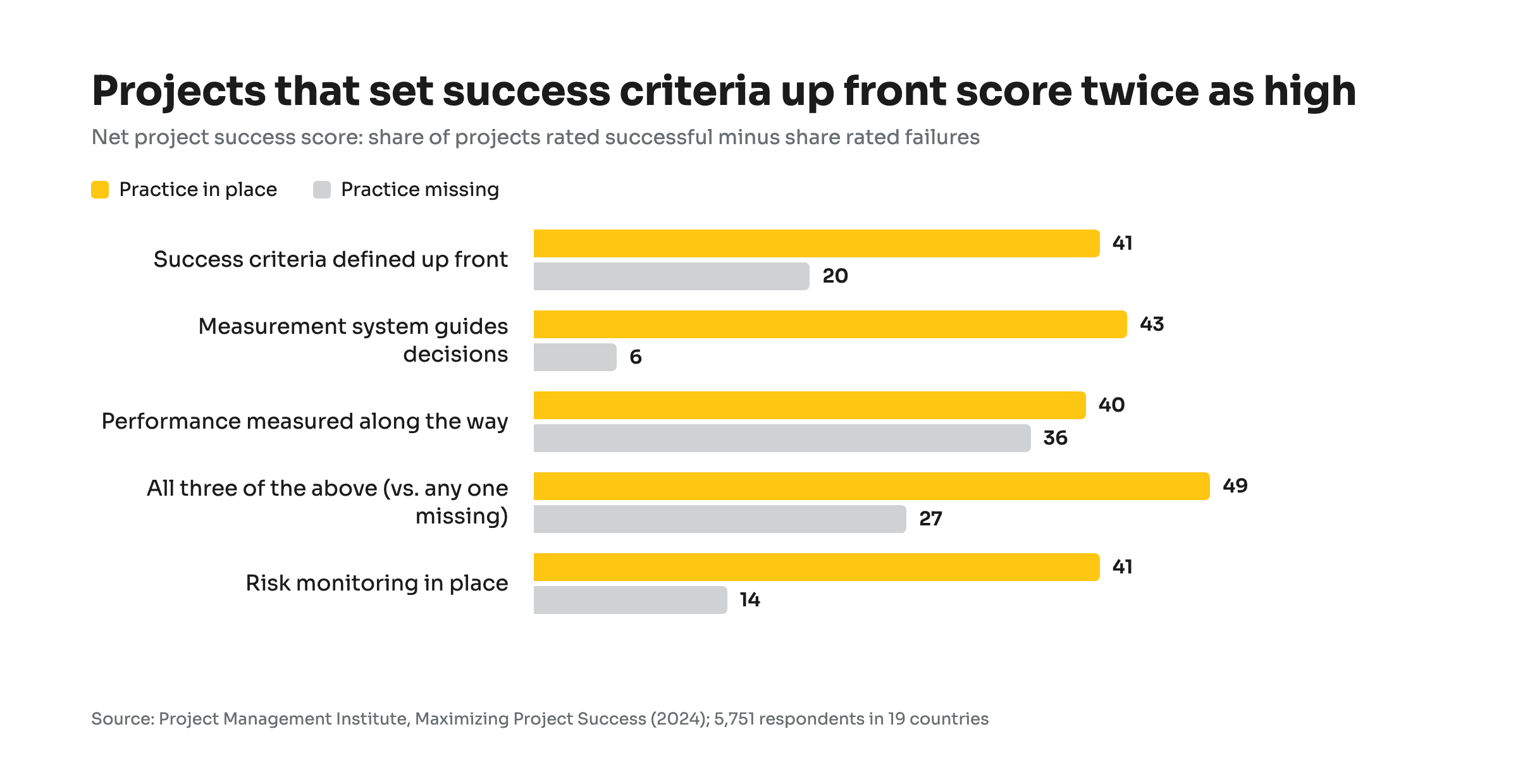
A good agency will push you to make those goals measurable. On our projects, success criteria are agreed at planning together with the scope and the acceptance criteria. Depending on the project they cover store speed, conversion rate, average order value and revenue, delivery on the agreed dates and scope, and staying within budget. We track them in Google Analytics, Shopify Analytics, and PageSpeed Insights, so both sides look at the same numbers.
Build a shortlist: what Shopify partner badges and reviews really tell you
With your goals written down, you can build a shortlist. The first two signals most merchants see are the partner badge and the reviews.
A Shopify partner badge is a tier Shopify assigns to service partners itself. Anyone can register as a Shopify Partner, but a badge has to be earned: Shopify tiers partners "based on multiple factors, including their history of experience and proven success on Shopify," as the badge description on directory profiles puts it. That makes a badge a strong first filter. Shopify itself has seen the partner do steady work with real stores. DevIT is a Shopify Select Partner, and we treat the badge the same way we suggest you do: as the start of a check, not the end of one.
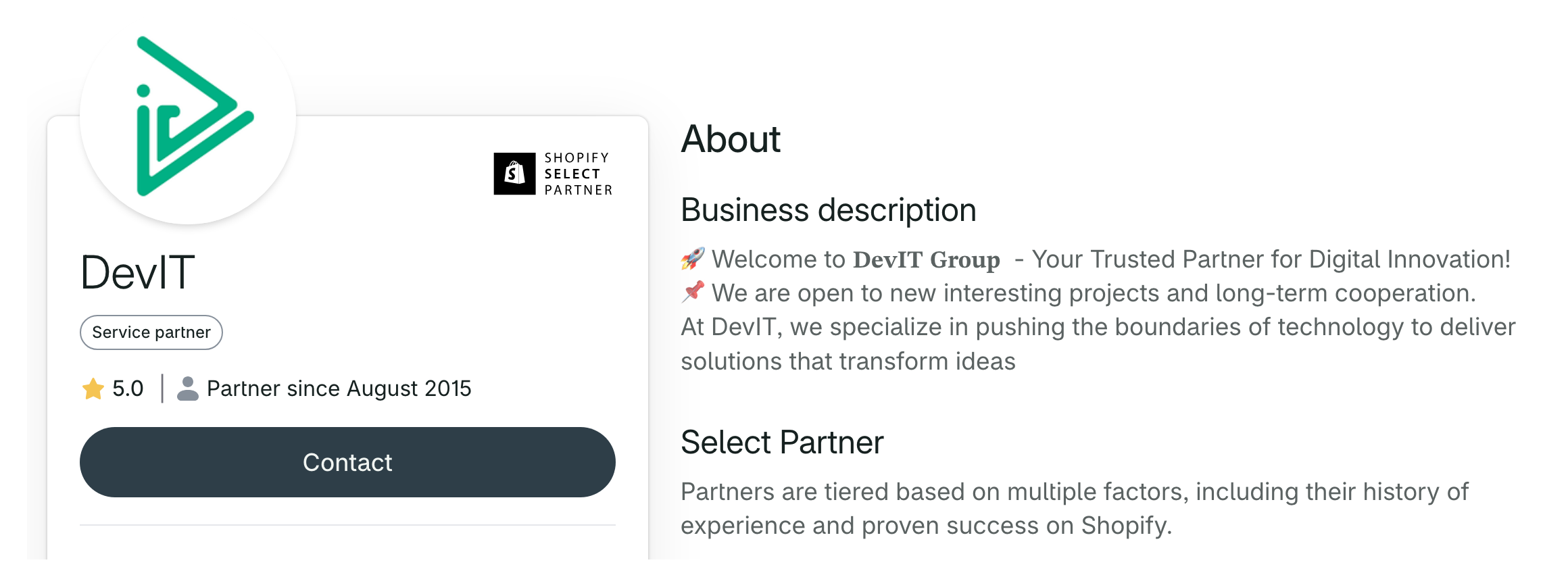
Reviews in the directory are genuine, but they show only part of an agency's track record. Under Shopify's rules, a merchant can review a partner only after accepting a collaborator access request sent from that partner's own account and working together for a minimum period, and the review is published only if the merchant is on a paid plan. Work that ran any other way leaves no trace there: for example, when an agency built a store as a subcontractor under another partner's account, or when the merchant gave the team access through staff accounts.
So read reviews in more than one place, and read them for specifics rather than stars. Clutch, GoodFirms, and Upwork collect reviews in their own ways. On Clutch, the words clients use most about working with us are "timely" and "communicative." In the Shopify directory, a medical supplies retailer described moving its store from Shopware to Shopify as handled professionally, with clear and reliable communication throughout. Another brand wrote about bespoke theme features and custom app logic that streamlined its operations. Reviews like these tell you what an agency is like to work with, which a rating alone can't. You can compare our profiles on the Shopify Partner Directory, GoodFirms, and Upwork, or see them all on our awards page.
What a good Shopify agency asks before it quotes
The first conversation tells you more than any portfolio. A good agency asks more than it talks, and what it asks depends on where you're starting.
There is a reason to pay attention to those questions. Whitelane Research surveys European companies every year about the IT service providers they work with. Its 2025/2026 study, published in February 2026, covers close to 7,000 IT sourcing relationships at more than 2,500 organisations. The weakness clients named most often was a provider that doesn't challenge their thinking, cited by 38%. Another 30% said providers rely on inexperienced people, and 27% pointed to too little knowledge of their business and industry.
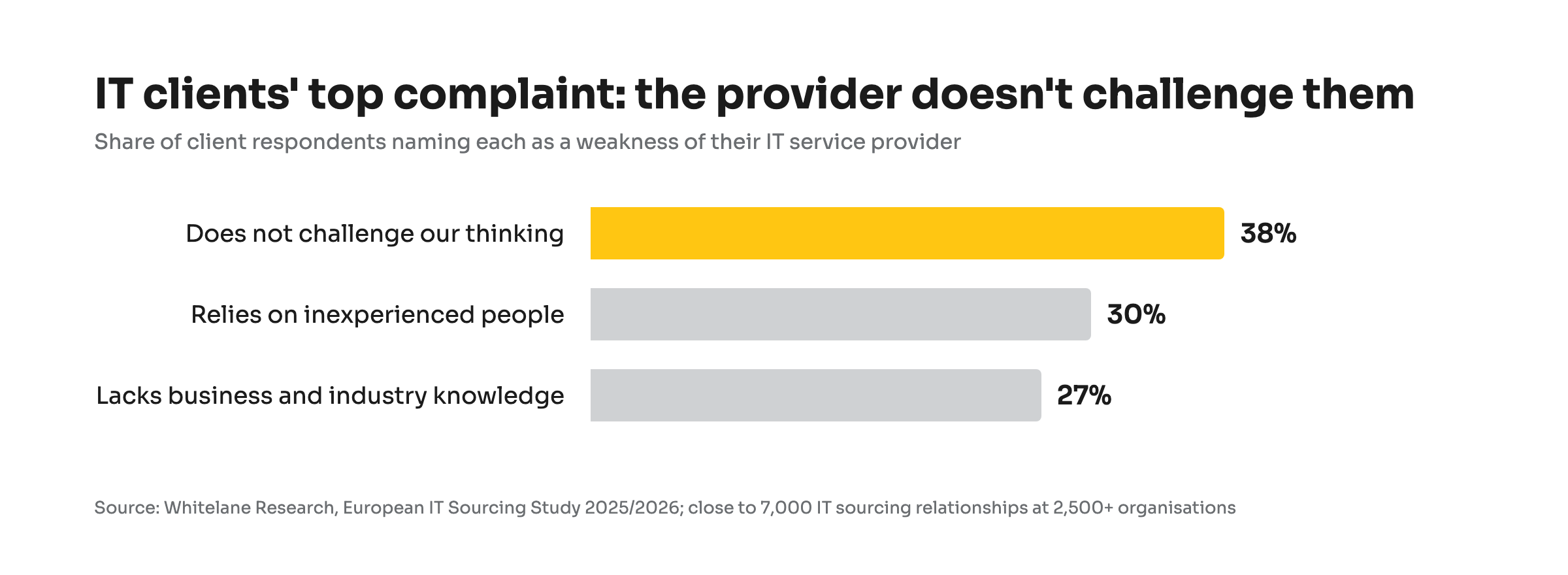
The study covers IT services in general, not only ecommerce, but these complaints are visible in the very first conversation. An agency that only takes notes and repeats your feature list back in a quote is showing the top weakness on that list before the project has even started. Here is what good questions should cover.
If you're launching a new store, expect questions about your catalog, how you sell, the systems the store must connect to, and the launch date. For Karst, a headless Shopify Plus store, the key requirements included a custom product builder, real-time inventory sync, and a B2B portal for wholesalers.
If you're moving from another platform, expect questions about your data, your URLs and search traffic, and which features of the old store must keep working. Our migrations cover full data transfer and SEO redirects as standard parts of the job, because a migration that loses search rankings is a migration that costs money.
How much it can cost shows up in the most extreme kind of move, a change of domain. A Search Engine Journal study updated in January 2025 followed 892 domain migrations. On average, the new domain took 523 days to reach the estimated organic traffic of the old one, and 17% still hadn't caught up after 1,000 days. The fastest recovered in less than three weeks. A move to Shopify usually keeps your domain, but the addresses of products and collections change, and search engines rely on the same redirects to carry rankings over. The author notes that some factors are outside anyone's control, but links the outliers to how each migration was carried out, which is the part an agency controls.
If you're improving a store you already run, expect an agency to want to look inside it first: the theme, the apps you already pay for, and anything left behind by earlier work. A quote without that step is a guess, and the next section shows why.
On our side, a new project starts with our presale team, who study the request and come back to you with questions. A tech lead and developers then estimate the work, our CTO checks the estimate, and you receive a written commercial proposal, usually within one to two days. More complex projects start with a separate discovery stage, where the team works through requirements, architecture, and integrations before anyone commits to a full plan.
Ask for an audit first: what we find inside stores built by others
Why insist on looking inside an existing store first? Besides building and migrating stores, we make five Shopify apps of our own. They are installed in thousands of stores that other developers built, and over the years our support team has worked inside thousands of them. That gives us a view most agencies don't have.
Here is a support ticket we see from time to time. A merchant writes that our app isn't showing up on their store. The app is installed, the settings are right, and on our test stores everything works. The cause turns out to be a single line of theme code that a previous developer left unfinished. Shopify relies on that line to know where to load the app, so without it the app never loads, and nothing warns anyone. The store looks normal, which is why a problem like this can sit unnoticed for months. Meanwhile the merchant keeps paying for a feature that isn't running, and the sales it was meant to bring never arrive.
One unfinished line is a small mistake with a real cost, and the same pattern shows up in other forms:
- Theme edits nobody documented. Custom code added by a previous freelancer breaks when the theme updates or a new app expects a standard setup.
- Apps that fight each other. Two apps that both change the cart, or a page builder that overrides a product page, cancel each other out.
- Code left behind by deleted apps. Uninstalling an app doesn't always remove what it added, and old scripts keep loading on every page.
- Shopify's own limits. Some features depend on the merchant's plan or on what Shopify allows at checkout, and no theme work changes that.
None of this is visible when you look at a finished store. That's why an agency that has spent years on the support side starts an existing-store project with an audit, the same check we recommend in our Black Friday store readiness guide.
When an app is enough and when you need a Shopify agency
An audit often ends with a simpler answer than a development project. Many needs have a ready-made app, and an honest agency tells you so, even when it means a smaller contract.
Because we build apps too, we can say this without a conflict of interest. If you want post-purchase and checkout upsells, ReSell does that. Product labels and badges are Lably. A slide cart with upsells is ShopCart; we wrote about how it passed Shopify's App Review in less than 24 hours. Sometimes the fix is even smaller: one merchant wrote in a review that our support team put together a custom script before they had even signed up for a plan.
You need a team when the request starts with "the app does almost what we need, but." Our support hears that sentence regularly: a merchant wants a rule the settings don't offer, a link to their ERP, or a layout no theme supports. At that point another app usually adds one more conflict, and custom development becomes the cheaper option. A new store with its own logic, a migration, a custom integration, or a redesign of a store that has outgrown its theme belong here too.
Compare proposals: five things a strong one includes
Whether the answer is an app, custom work, or both, it should come back to you as a proposal. When a Shopify agency sends one, read it for more than the price. A strong one shows that the agency understood your business, not just your feature list.
Look for five things:
- Scope in plain words: what will be built, and just as important, what won't.
- Success criteria: the goals from the first step, turned into numbers and acceptance criteria.
- Risks: missed dates, lost search rankings after a migration, apps that may conflict. An agency that names risks at the proposal stage has looked at your project properly.
- Timeline and budget: with the assumptions behind them.
- How changes will work: what happens when you ask for something new halfway through.
Every proposal we send has a section on risks, technical constraints, and dependencies that could affect the project. If those parts are vague in a proposal, they rarely get sharper once the work begins.
How the work should run once you hire a Shopify agency
Once you sign, the question changes from "can they do it" to "will I know what's happening." You should know the people, not just the company, and hear from them without having to chase.
Large technology programs show what happens when nobody owns that. In a 2024 study of more than 1,000 executives in 59 countries, Boston Consulting Group looked at programs that took more than 3% of a company's annual tech budget. Only 30% of companies fully met their expectations for timeline, budget, and scope, and 35% missed all three. Asked why programs fell short, more than 60% of respondents pointed to the lack of an end-to-end master plan with timeline and resourcing, and 60% to the lack of an active program management office. 57% named missing joint leadership from the business and technology sides.
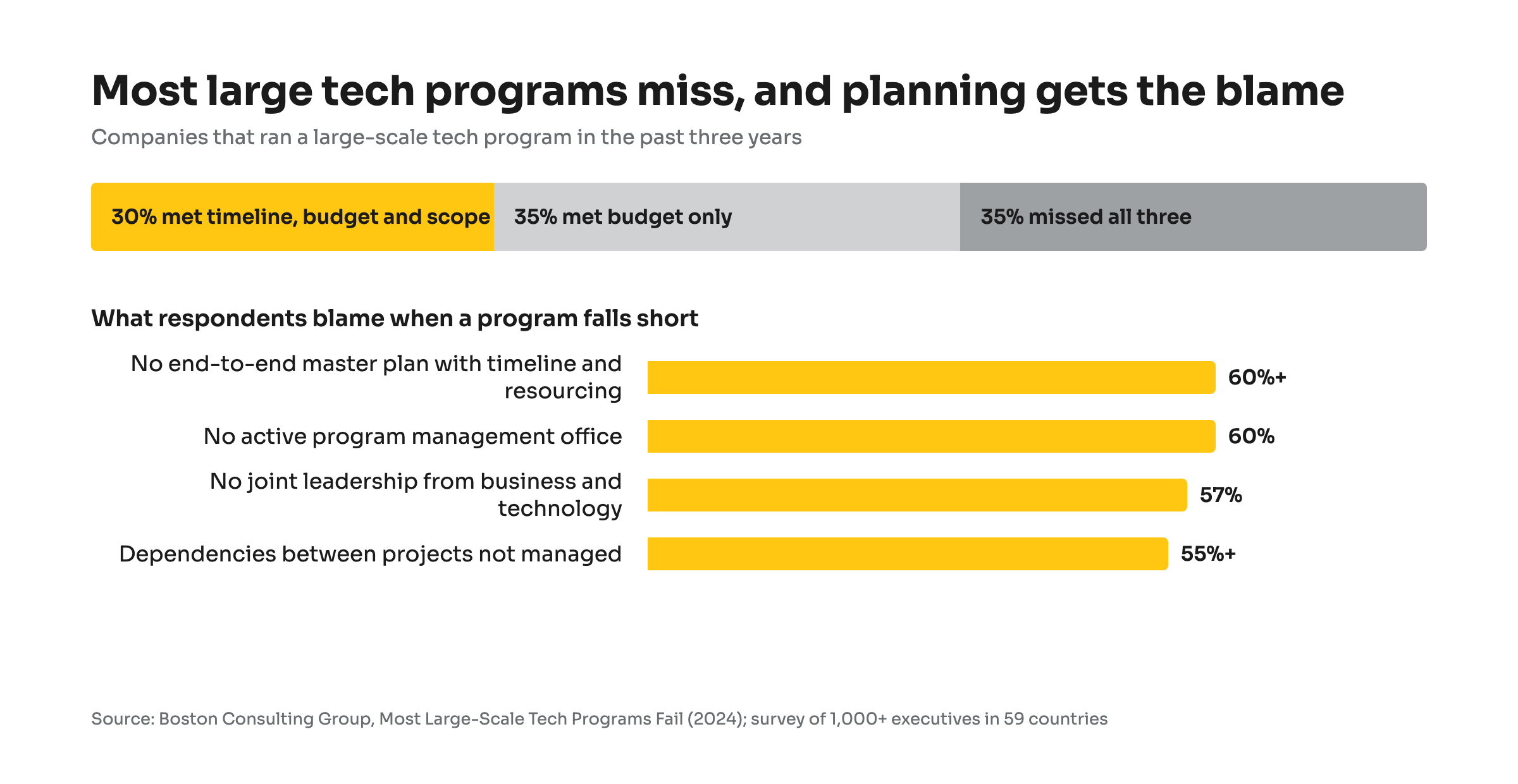
A store project is smaller than those programs, but the weak points are the same, and you can check each one in an agency before you sign: who owns the plan, who runs the project day to day, and who keeps business goals and technical decisions in the same conversation.
On our projects, a dedicated project manager runs the work from start to finish, coordinates the team, sends regular progress reports, and shows finished features in demos. QA engineers test throughout the project, not only at the end. Some clients name the specialist who helped them in their reviews, which is a good sign to look for in any agency's reviews.
New requests will come up; they always do. What matters is that each one is handled the same way. Ours goes back through the same path as the original request: presale clarifies it, the tech lead estimates it, our CTO checks the estimate, and you get it in writing before anyone builds it. Small clarifications fit into the current plan, and anything that changes scope, budget, or timing is agreed first, by email, in the task tracker, or as an updated scope of work.
Agree on life after launch before you sign
Launch is where many agency relationships quietly end, and where store owners find out what they actually bought. Settle it while you are still choosing.
Three things matter. First, support right after launch, when real customers find what testing missed. We include two weeks of support after go-live to catch and fix issues in what we built. Second, a clear format for the long run: we continue by the hour, on a monthly retainer, or with a package of hours, agreed with each client. Third, ownership. You should receive the source code, repository and admin access, technical documentation, and setup instructions, and the code should belong to you. With us, it does.
Seven questions to ask every Shopify agency on your shortlist
Here is the whole guide in seven questions. Ask them in the first call and compare the answers side by side.
- What does success look like for my business, and how will we measure it?
- What do you need to understand before you quote, for a new store, a migration, or the store I run?
- What would you solve with an existing app instead of custom work?
- Who will work on my project, and who is my point of contact?
- How do you handle new requests once work has started?
- What risks do you already see?
- What happens after launch, and who owns the code?
Why we wrote this guide
DevIT has built software since 2013 and worked on Shopify since 2015, and we answer these questions for our own clients every time we start a project. Browse our Shopify portfolio and our Shopify development services, or read the lessons we've learned from our client work.
Planning a new store, a migration, or changes to the store you run? Tell us about your project, and we'll start with the questions from this guide. If an app is all you need, browse our apps on the Shopify App Store.