


Every support team is being told that AI will take over its inbox, and vendor demos answer every question perfectly. It is hard to tell what that means for a real product with real customers. We wanted a real number for AI customer support for Shopify apps, measured on our own conversations, before we changed anything in how we work. So we took 90 days of support for the Shopify apps we build and run at DevIT Software and asked one question of every conversation: what did it actually take to resolve this?
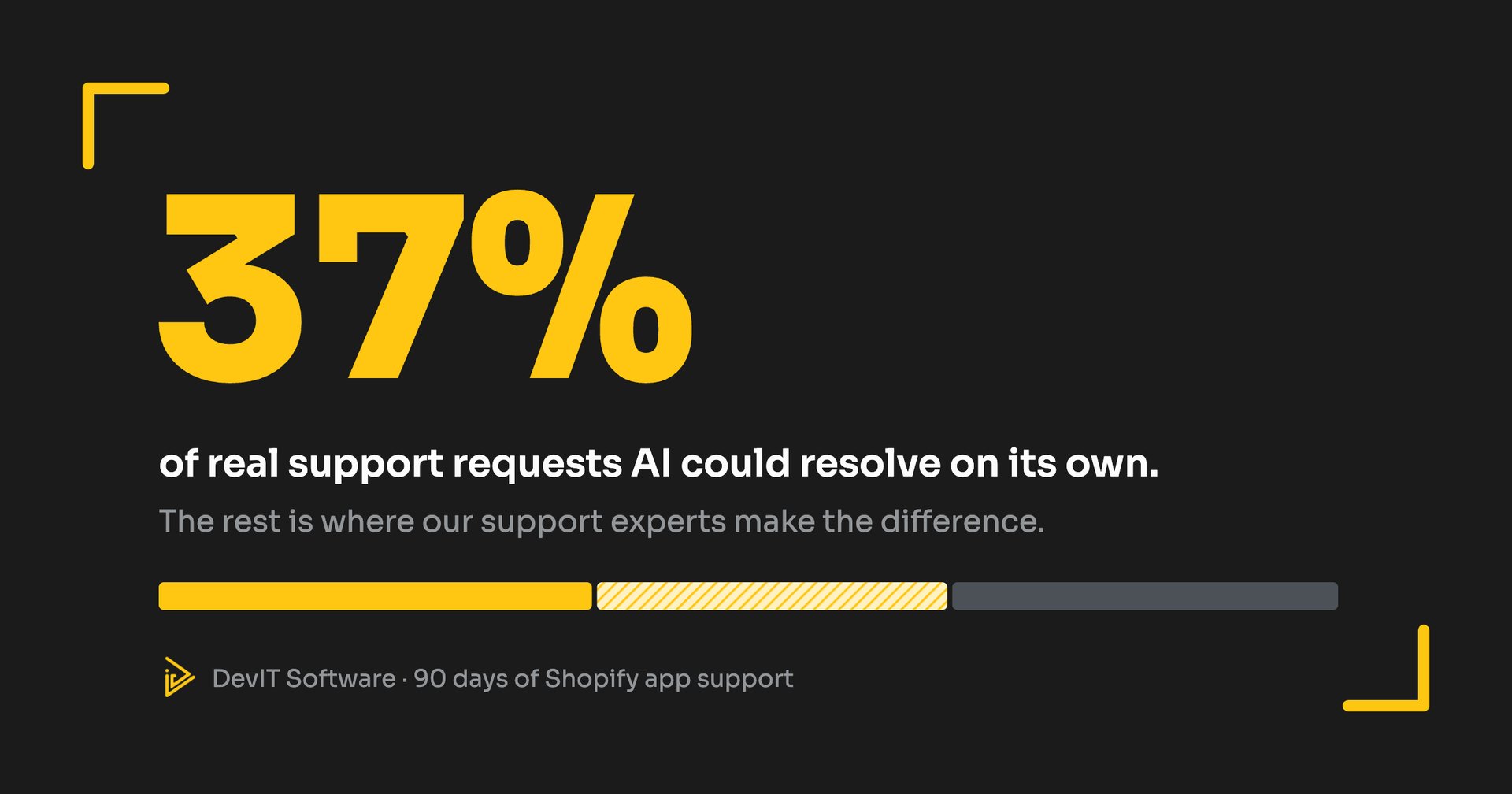
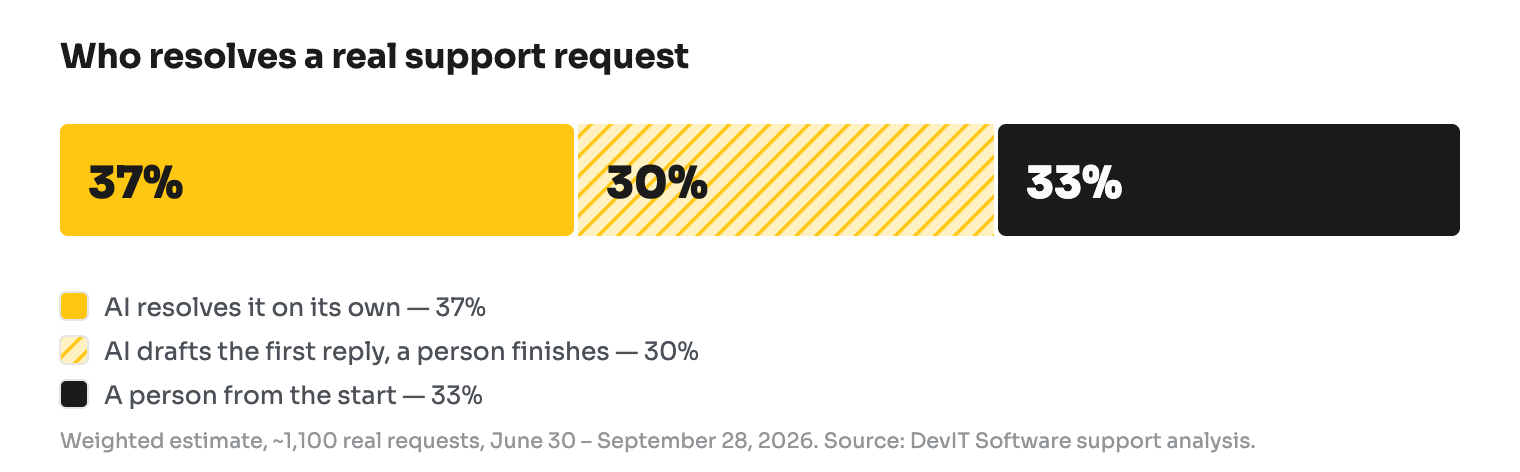
The answer is that AI could resolve 37% of real customer requests without an operator, and help with the first reply in about two thirds of them. For a team handling around 370 requests a month, that is roughly 135 tickets nobody would need to touch. For us, that is a strong result, and this article explains how we got it and what we are doing with it.
How we measured it
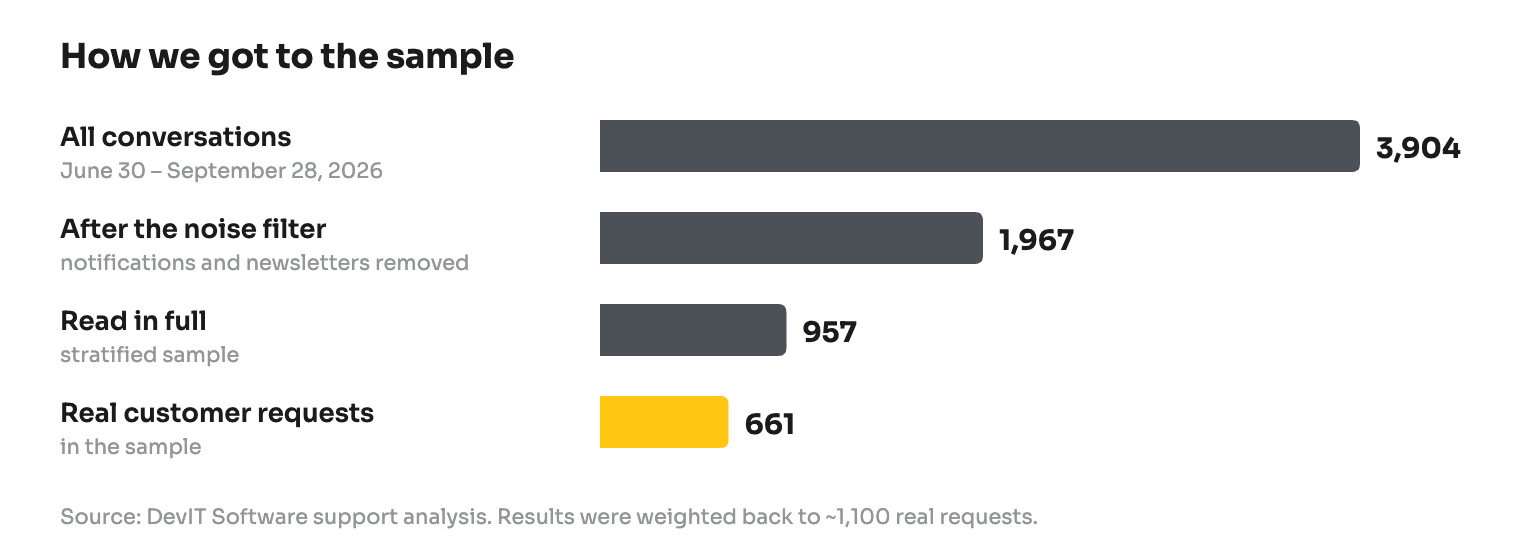
We took every support conversation active across our apps between June 30 and September 28, 2026, mainly ReSell, Selecty, Lably, React Flow, and ShopCart: 3,904 in total. After filtering out automated notifications, newsletters, and outbound messages nobody replied to, 1,967 were left. We read a stratified sample of 957 of them, every conversation in the busiest queues and a share of the rest, going through every message including internal notes. The sample held 661 real customer requests, and we weighted the results back to all of the roughly 1,100 real requests in the period.
Each request got one verdict based on what it would have taken to close it:
- AI alone, with an existing help article. The answer is already documented.
- AI alone, if the article existed. The answer is knowable, but not written down.
- A person in the store. Someone has to open the merchant's theme or admin and check, click, or configure.
- A developer. It is a bug or needs a code change.
- A human decision. Billing exceptions, discounts, commercial questions.
An AI model read the conversations through our support platform's API, under a written rubric that forbade any changes, and nothing in the conversations was modified. We publish only aggregate figures: no customer names, stores, or messages appear in this article.
What AI can handle: 37%
- AI, help article exists: 26%
- AI, if the article existed: 11%
- AI on its own: 37%
- A person in the store or admin: 48%
- A developer: 8%
- A human decision: 7%
The clearest win is "how does it work" questions: AI can answer almost all of them, and for most the help article already exists. Rule-based billing questions and plan limits fall into the same group.
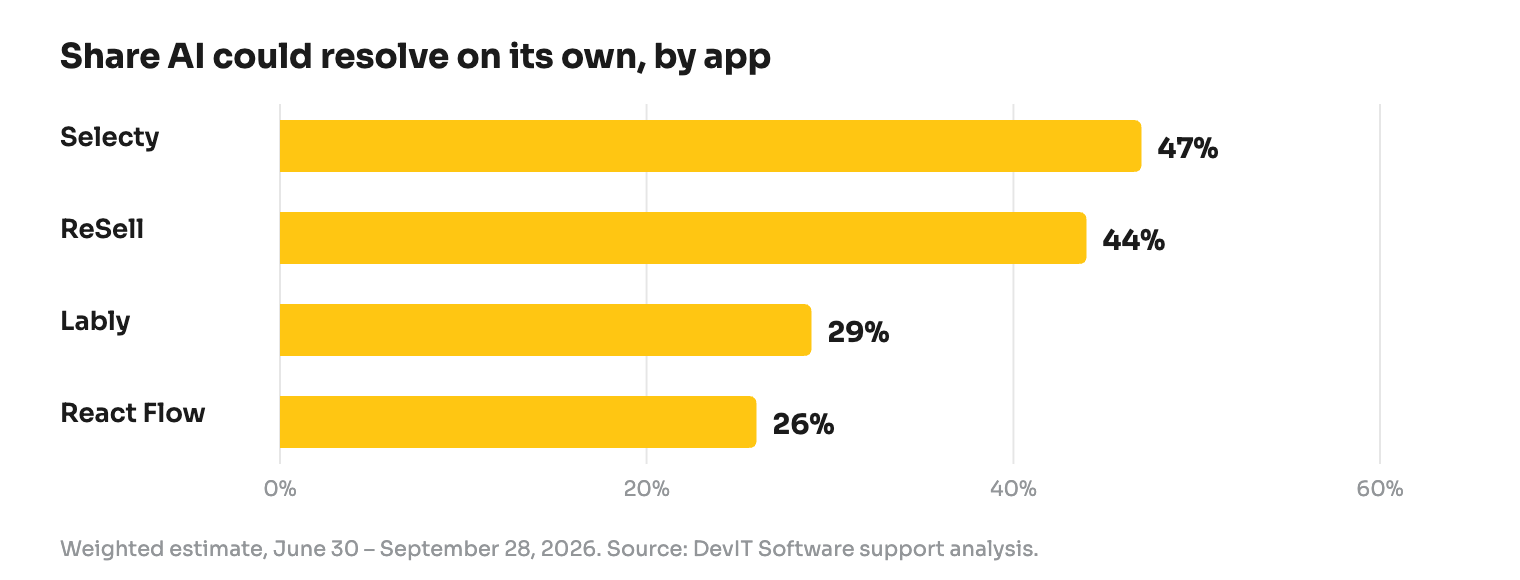
The picture also differs by app. AI could resolve 47% of Selecty requests and 44% of ReSell requests on its own, compared with 29% for Lably and 26% for React Flow. The last two have more questions that depend on the merchant's own theme or workflow.
Where AI speeds people up: another 30%
The 37% is only part of the value. In another 30% of conversations, AI could give a correct first reply from the documentation, some of it still to be written, and a person would then finish the job. The merchant gets an answer in seconds instead of waiting for the queue, and the operator starts with context instead of a blank reply box. Taken together, AI is useful in about two thirds of all requests.
How 37% compares with published numbers
Published figures range from a measured 14% to a predicted 80%, mostly because they measure different things:
- Self-service: 14% (2023). In Gartner's survey of 5,728 customers in December 2023, only 14% of service issues were fully resolved in self-service. The most common reason it failed was that customers couldn't find content relevant to their issue (43%) (Gartner).
- A leading AI agent: 76%. Intercom reports a 76% average resolution rate for its Fin AI agent across its customers, by its own definition of a resolution (Intercom).
- The forecast: 80%. Gartner predicts that by 2029 agentic AI will resolve 80% of common customer service issues without a person (Gartner).
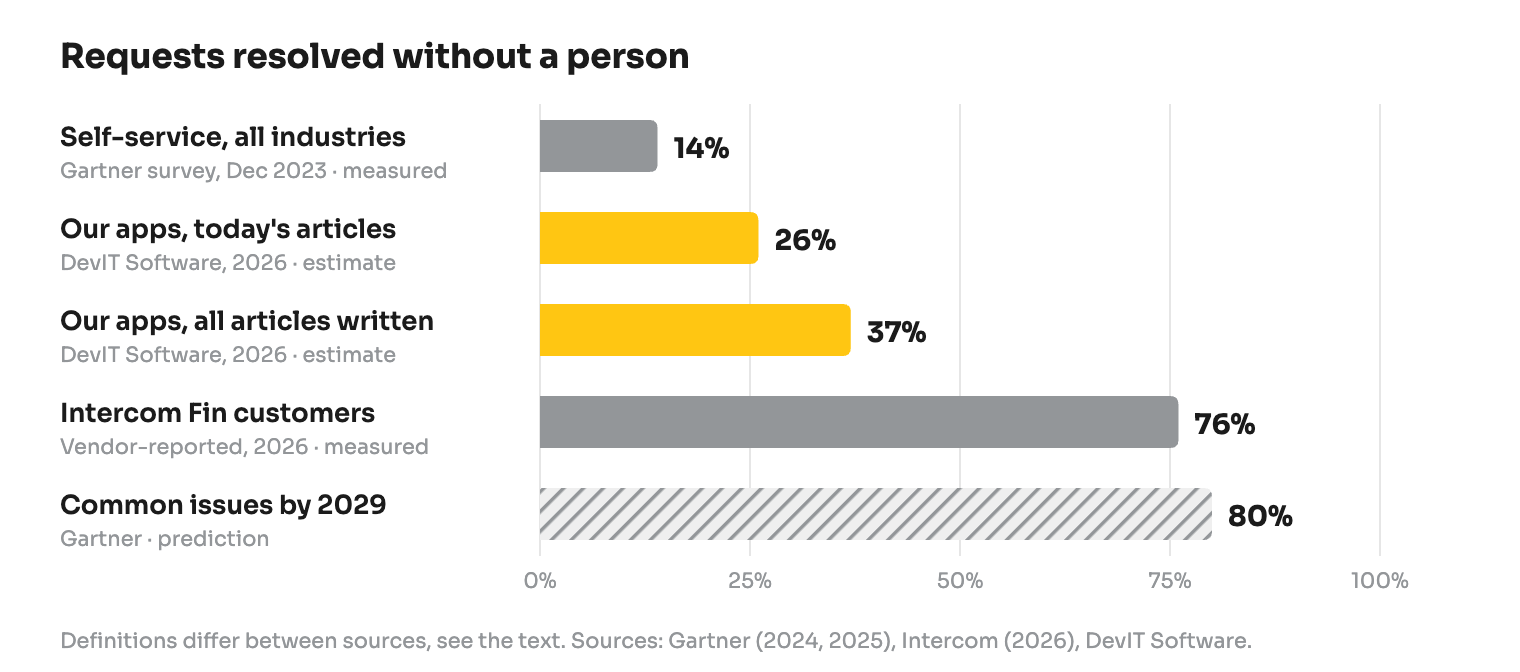
Our 37% is an estimate of what AI could close, measured one conversation at a time. It sits well above what self-service delivers and well below the vendor average, and our data shows why. About half of what our merchants ask is setup inside their own store, work that AI can't do from a chat window. A queue made mostly of questions with one documented answer will score higher. Gartner's 43% and our 11% point to the same lever: missing content is the cheapest problem to fix.
Finding the bottlenecks in our help guides
The most practical outcome was one we didn't plan for. An analysis like this shows exactly where an app's help guides fall short: which questions customers keep asking that the documentation doesn't answer. For 11% of requests, the only thing missing was an article.
The gaps fell into a few groups:
- What the app doesn't do, and the workarounds. The most common missing article across every app.
- Moving to Shopify's new app billing. How to pick a plan again and what happens to older plans.
- Size and position on mobile and desktop. Mostly for product labels.
- Workflow recipes. Ready examples for common React Flow automations.
That list is now our documentation roadmap. Every new article moves requests from "needs a person" to "AI can answer" and helps merchants who never open a chat.
The work only our support team can do
Almost half of all requests, 48%, need someone inside the merchant's store. Setup questions make up about half of everything customers ask, and nearly nine in ten of those need hands in the store: finding the right CSS selector for a theme nobody on our side has seen before, checking markets and redirects as a shopper in another country would see them, building a workflow together with the merchant, or tracing why an upsell funnel isn't showing.
That is expert work, and it is what our support team does best. They know our apps from the inside, they read an unfamiliar theme in minutes, and they stay with a problem until it works for the merchant. Merchants notice. "Their support team is perhaps the best you will find on any Shopify app" wrote a React Flow merchant on the Shopify App Store.
This is why AI in our support is a tool in our team's hands. It takes the routine questions and drafts first replies, and it works only because a strong team stands behind it.
What customers expect from AI in support
Our merchants are business owners and operations managers who value their time. They want the problem solved quickly, by someone who knows the product, and research says the same of customers in general:
- Most customers are wary of AI in support. In the same 2023 Gartner survey, 64% said they would prefer that companies didn't use AI for customer service, and 53% would consider switching to a competitor over it (Gartner).
- A person has to be one step away. In early 2026, 87% of 3,566 customers told Gartner that a company using GenAI must offer access to a human agent, even though half said AI made their interactions easier (Gartner).
- A bad bot experience is hard to undo. In the same survey, only 27% said they would try a chatbot again after a negative experience (Gartner).
- People still prefer people. In a SurveyMonkey study of 2,017 US adults in December 2025, 79% strongly preferred a human over an AI agent, and 89% said companies should always offer the option to speak to one (SurveyMonkey).
The research and our data point the same way. AI works in front of a strong team, answering simple questions fast and handing the rest to a person who knows the product. Without that team, it becomes a wall between the customer and a solution.
What this analysis can't tell you
The verdicts were assigned by an AI model following a written rubric, with no separate human audit. "An article exists" says nothing about how good that article is. Where part of a conversation happened by phone, we only saw the written part. We treat the numbers as a careful estimate, and we will measure again once the new help articles are live.
AI customer support for Shopify apps: what it means for yours
If you run a Shopify app or a store with its own support team, the number worth knowing is your own. Generic deflection rates hide which of your requests need a person and which only need a better help article.
We can run the same analysis on your support inbox and turn it into a documentation plan and an AI setup that fits your team. Tell us about your support, or see how we build and run Shopify apps. You can also read how we approach automating Shopify business processes.